An unofficial blog on the archaeological excavation at Horbat Omrit, northern Israel. 22 May to 22 June 2010.

Thursday, June 10, 2010

Thursday, June 10

First let me tell you about that pottery I had a picture of yesterday - I got a query and I, unthinkingly, had thought everyone would know what it is. It is an oil lamp, sometimes called a boat lamp from it's shape. Olive oil into the big hole and a flame from the small hole.

Allison and Sarah are guest blogging today:

Hello! This is Sarah and Allison from Bill’s square, your guest bloggers for the day. Today was kind of boring - we continued taking down the tumble in our square and moved a lot of rocks out of the way. So we’ll talk about the highlights of the last few days instead.

On Tuesday, we took a walk to the Jordan river. It’s a pretty walk, with fields of sunflowers and apricots on the way. Here’s a picture of Allison with the sunflowers:
And Sarah at the river:
Yesterday, Allison went to visit Tel Hai College, to meet up with students from the Center for Peace and Democracy, whom her “Background to the Modern Middle East” class at Macalester skyped with several times. At the meeting, they talked about the recent flotilla incident and planned for future joint Macalester/Tel Hai classes.

Meanwhile, Sarah went to a Golan Heights winery with Bill and some others. We toured the winery and had a wine tasting of all the local varieties.

Sarah and many others drink “spa water,” which is regular water in a bottle with cucumbers, lemons and sometimes mint. We’ll get Bill to post a picture of this deliciousness soon.

We would also like to mention that Bill’s wheat lecture yesterday was awesome. Who knew there was so much to say about wheat!

And finally, a nice photo of the sunrise over Syria. It almost makes getting up at 4:30 am everyday worth it. Almost.

Wednesday, June 9, 2010

Wednesday, June 9

Today I'll give you a picture of our current square. We cleared most of the dirt from the tumble of rocks holding up the dirt mound and will soon clear those rocks and work down to surface layer. A lot of dirt. There was some surprising pottery found on the edge of that mound, the nicest of which will be the 2nd picture:
And here's a picture of almost all our crew:

Tuesday, June 8

Boy, if one doesn't blog daily, it's hard to catch up. I think for today I'll give you the final picture of the square we finished. With all those column drums:Also tonight I gave a presentation I developed on Emmer wheat. This wild crop, from which our modern wheats arose, grows as a weed in this area of the world, say within a 100 miles of where I'm sitting. And only here in any great amounts. And surprisingly, this wild plant was only discovered by western science 100 years ago. This from the New York Times in 1912:

Monday, June 7, 2010

Monday, June 7

Hello blog followers! Bill has asked me to guest-blog, and to inform people of other site developments.

My name is Lindsay, and I co-supervise square O12, which is a semi-isolated square located Northeast of the temple complex, and South-southwest of the Colonnaded way/Industrial Complex. Our square is not part of the temple complex, or the industrial area, but rather sort of a mystery section of the site. The best explanation for this area is that it is potentially an early Christian basilica. The next-door- neighbor square, N12, was excavated last year (by yours truly), and some of the architectural features helped to create this hypothesis.(The square before excavation)

Unfortunately, O12 was once the dump site for another square in the area, meaning we were digging through dirt and rocks for about 50-150 centimeters. Although we found staggering amounts of pottery—about 2000 or more pieces by my current count—and bone (including a complete animal jaw which jumped out of the balk, scaring Shannon quite a bit), it took us nearly a week and a half to do more than simply move dirt out of the square. However, this week we found a water pipe system that is incased partially in concrete, partially in bedrock that had been cut for the purpose. We have found, as of today, 2 broken systems of water pipe, and one complete, in situ pipe that runs under the bedrock. Kate, my co-leader, swears that this section smells fleetingly of death, and although several haikus have been written on the topic, the smell has not been confirmed. Additionally, we found a complete floor. Our group was originally excited to find a wall in our square; however, a floor is nothing to scoff at. Also, I learned from Andy that the best way to test whether an architectural feature is a floor or a wall is to take a nap on it—and for the record, our floor is very comfy. This test is not unlike the test where you lick a rock to determine whether its pottery or not. (The floor—above in the raised section of dirt is the location of the water pipes.)

After pottery reading the fate of our wall/water system is unclear. In the words of the ceramist, 99% of our findings are from the 5th-6th century Byzantine period, but one or two pieces of Early Roman Import or 13th century Crusader pottery is completely throwing off the dating of our square. Hopefully, the last few pieces of pottery we find (which are on or below the floor) will provide a clearer picture the date and purpose of the features in our square, hopefully providing a bit more illumination to the site.

Soon we will be opening O11, which is a square directly south of ours, and the process will begin again. This time, however, we may, in fact, find a real wall, or, as rumor has it around the square, the gates to the underworld.

Until then, here’s a photo of the wonderful team that is (on any given day) the “Boisterous Band of Byzantine Bandits in a Bucket Brigade”, or “Hydration Station” at Bet She’an:Lindsay Morehouse

Sunday, June 6, 2010

Sunday, June 6

Today is an off-day and most of the masses went on a tour of Beit She'an, an amazing Hellenistic/Roman city of the Decapolis just south of the Sea of Galilee.

But both John and I have been there before and, having our own wheels, we decided to visit another site near the Sea of Galilee: Gamla.

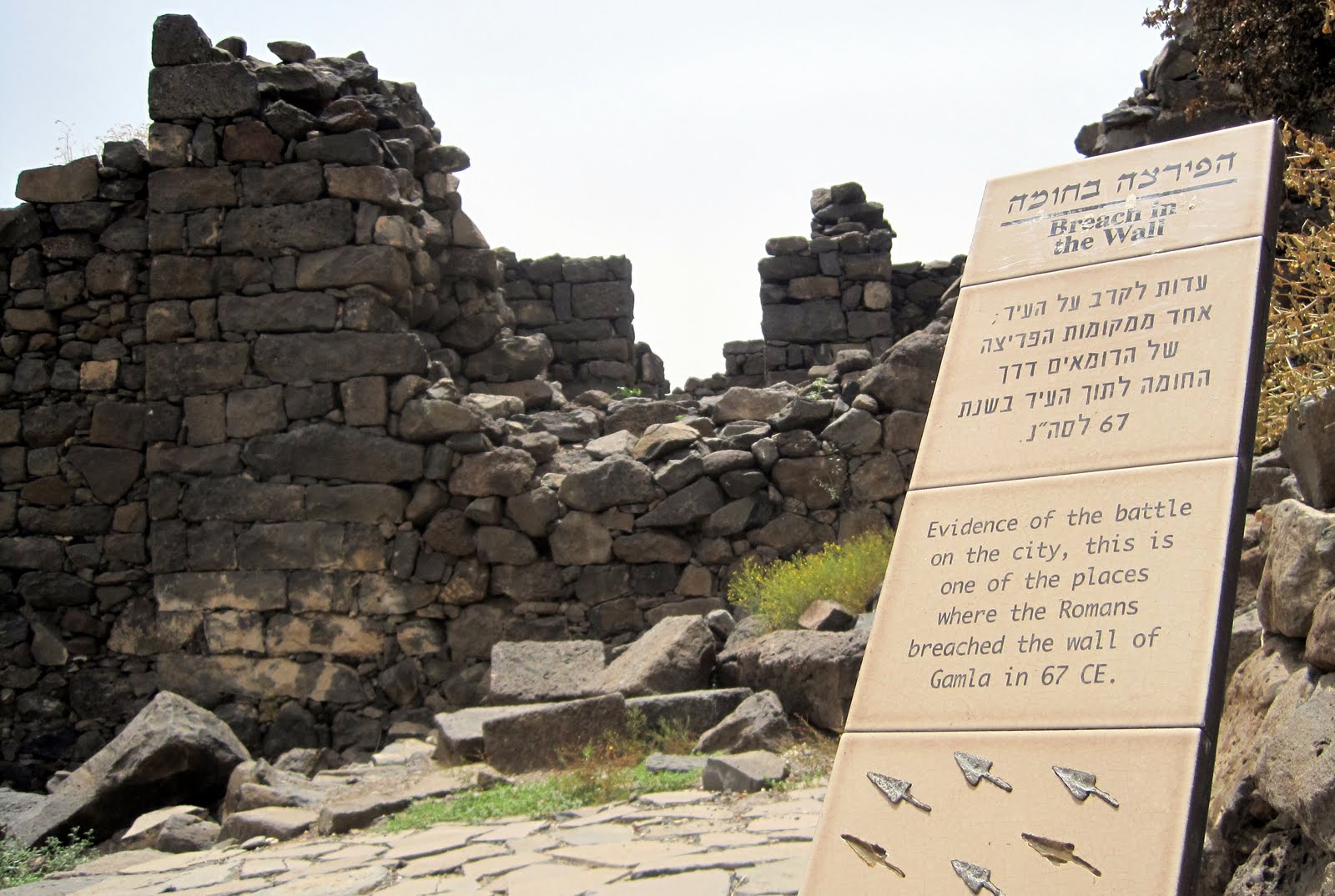
Gamla, like Masada a few years later, held out against the Romans in 67 CE during the Jewish Revolt. Well, for a while they held out, but were eventually utterly destroyed. The Romans were masters of military violence.

Gamla is on a high ridge between 2 valleys so only needed one wall and was easy to defend. The people of Gamla had hope that they could outlast 3 Roman legions. No way. See the link above for further information.

Here you see the ridge between the valleys that is Gamla:(Don't forget to zoom!) In the far distance (we're looking west), over those hills, is the Sea of Galilee. There was a grass fire a few weeks ago that darkened the landscape.Here's a breach in the wall made by the Romans:Here's my roomie John, who traveled down from Canada to be here, next to the car we rented for the month here.

Saturday, June 5, 2010

Saturday, June 5 Update

Well, My group met for the pottery reading and it came out fantastical, at least from my perspective. And the way one hopes and the way it should, but, of course, it doesn't have to. The date readings on our pottery, collected in small increments, depth-wise and geography-wise generally contained more that one possible range of dates. But those ranges got older and older the deeper we went. The upper buckets tended to be 13th century Islamic (The last time there was habitation at Omrit, that we know of) and the deepest buckets were Early and Middle Roman. This was to be expected but it's nice confirmation that my square is digging correctly and carefully. If you pick up a Coca-Cola bottle cap in your deepest layer, it totally destroys your dating.

Oh, here's Amy, whose mother is following the blog.

Saturday, June 5

A half-day of work on the Jewish sabbath but then we can travel on Sunday and tourist sites will be open. Here's a shot of our new square. Note the mound in the background that has to be dug through and the exposed column capitals in the foreground and the left background.During the rest of the day, a pottery expert from Jerusalem has come up to date our pottery. By pottery, I mean small pieces and chips. Most is not useful but some is "indicative". Each square meets with her in turn and we take furious notes. This will be part of the permanent record of our square. Here is a group meeting this afternoon under a tree:We haven't collected much pottery in our square of tumbled column drums. Here's our measly stash waiting to be evaluated.